Drywall Repair in Soledad, CA
Hairline cracks over doors and windows, holes from doorknobs and furniture, dented corners and water-stained ceilings, repaired and finished with orange-peel or knockdown texture blended into the wall around them.
One call is enough: a drywall contractor nearby rings you back, hears what happened and arranges the quote.
Call 7 days, 7am–9pm
Sending this okays phone calls and texts from Soledad Drywall Repair Co. and the local contractor pricing your repair. Privacy notice
Your note reaches the contractor nearest the job, and you get a call to discuss the damage before any price is written.
Homeowner or Pro
Some drywall damage is a reasonable afternoon project for a careful homeowner. Other damage has wiring, plumbing or moisture behind it, and that is where a fast coat of spackle covers a problem instead of fixing it. This is how we would sort the two in a Soledad house.
For longer reads, our drywall repair guides go deeper on single decisions.
Reasonable at Home
Nail holes, small dings, and a hairline crack a few inches long that hasn't grown since you first spotted it. A tub of light spackle, a thin blade, a fine abrasive pad and a dab of primer handle that. Lay a drop cloth, wear a dust mask while sanding, and keep the strokes light so the gray paper skin of the drywall stays unbroken.
Texture is the part that trips up most home patches. A smooth spot on an orange-peel wall stands out plainly once low light rakes across it, so a can of spray texture and a few practice passes on cardboard first are worth the trouble.
Better With a Pro
Anything bigger than your hand can cover, any crack that returns after you've filled it, cracks running diagonally off the corner of a door or window, and any wall or ceiling that has been wet. Those need the damaged gypsum trimmed away until only firm board remains, a new piece fastened to framing, tape, several coats of compound and a texture that blends with what's around it.
Cutting into a wall also means knowing what sits behind it. An outlet or switch nearby usually means cable in that cavity, and kitchen, bath and laundry walls often carry supply lines. The careful order is the circuit switched off at the panel, then a look inside the cavity, and only then the saw.
Job Sequence
Every repair we book follows one order, so no wall gets opened before you understand the work and what pushes its price up or down.
The about page covers what we handle and the habits worth asking for on any repair.
First Contact
Dial the phone number shown up top, write a few lines through the message page, or send a snapshot to the number by text message. A picture of the whole wall plus a close one with a ruler or a quarter beside the damage shows how big the repair is.
Pricing Conversation
A drywall contractor working near Soledad returns your call, goes over what happened and arranges the quote. No wall is opened and no compound goes on before you have that number and say yes. The price moves with the size of the damage, wall or ceiling, how many separate spots there are, whether wet board needs drying time first, the texture to blend, and whether you want paint or just primer.
Dates Set Up Front
Each coat of joint compound needs to set before the next, so even a modest repair usually spans more than one day. The schedule is agreed with you at the start, so you know which days the room is out of use.
Contained Work Area
Good practice is to shield the room before any dust is made: floors and furniture covered, plastic over the doorway where sanding dust could travel, and nearby heating and cooling returns covered so dust isn't pulled through the house.
Primer-Coated Finish
The finished patch gets its texture and a coat of primer, so your own paint can go straight on. If you'd rather have it painted too, say so when the quote is arranged.
Repair Types
From wall and ceiling crack repair to a ceiling rebuilt after a leak, every repair type gets a page of its own on the method, the cautions and the points to raise when you call.
Timing Priorities
Not every mark on a wall needs attention this week. The left column is worth acting on soon; the right can wait until it suits you.
Sooner
- A stain that is still damp or spreading
- Water is still finding a way in, and soaked gypsum weakens and invites mold for as long as it stays damp.
- A ceiling that bulges or sags
- Before anything else, flip off the breaker serving the nearest ceiling light or fan; next, send everybody out of that room and slide a pail under the low point. Board heavy with water can drop all at once.
- A crack that keeps getting longer or wider
- Pencil a mark and the date at each end so you can tell whether it is moving, and bring it up on the phone. Doors that suddenly bind in their frames belong on the same list.
- A hole beside an outlet or switch
- The cable behind it may be exposed. Keep fingers and objects out of the opening until the circuit is off and the hole is closed.
Later
- A hairline crack that holds its size
- Cosmetic. Leave it until a quieter month, or fold it into one quote with other small repairs.
- Nail pops
- The fastener has backed out a little. Waiting until there are a few to reset at once is perfectly sensible.
- An old, dry stain from a leak that has been fixed
- No rush, provided the leak is fixed and a meter shows the board dry. A stain-sealing primer goes on before paint.
- Scuffed or dinged outside corners
- Cosmetic, unless the metal bead is bent outward where a hand or a sleeve could catch on it.
Ceiling Trouble
Ceilings fail differently from walls: gravity works on every fastener, and water from above shows up there first.
Brown Rings Overhead
A ring the color of weak coffee on the ceiling means water reached the board from above: a roof leak in the wetter winter months, a bathroom on the second floor, or condensation from an attic duct or an air conditioner's drain line in summer. The ring is what the water left behind as it dried, and painting straight over it tends to let it bleed back through the new coat.
Drooping Panels
Ceiling board that dips between the framing has lost its hold on the fasteners, usually from water weight and sometimes from too few screws when it went up. If the sagging spot looks swollen or damp, first flip off the breaker serving the ceiling light or fan in that part of the room, then move children and animals clear of the spot. Don't push on it or poke it with a broom handle.
Seasonal Corner Gaps
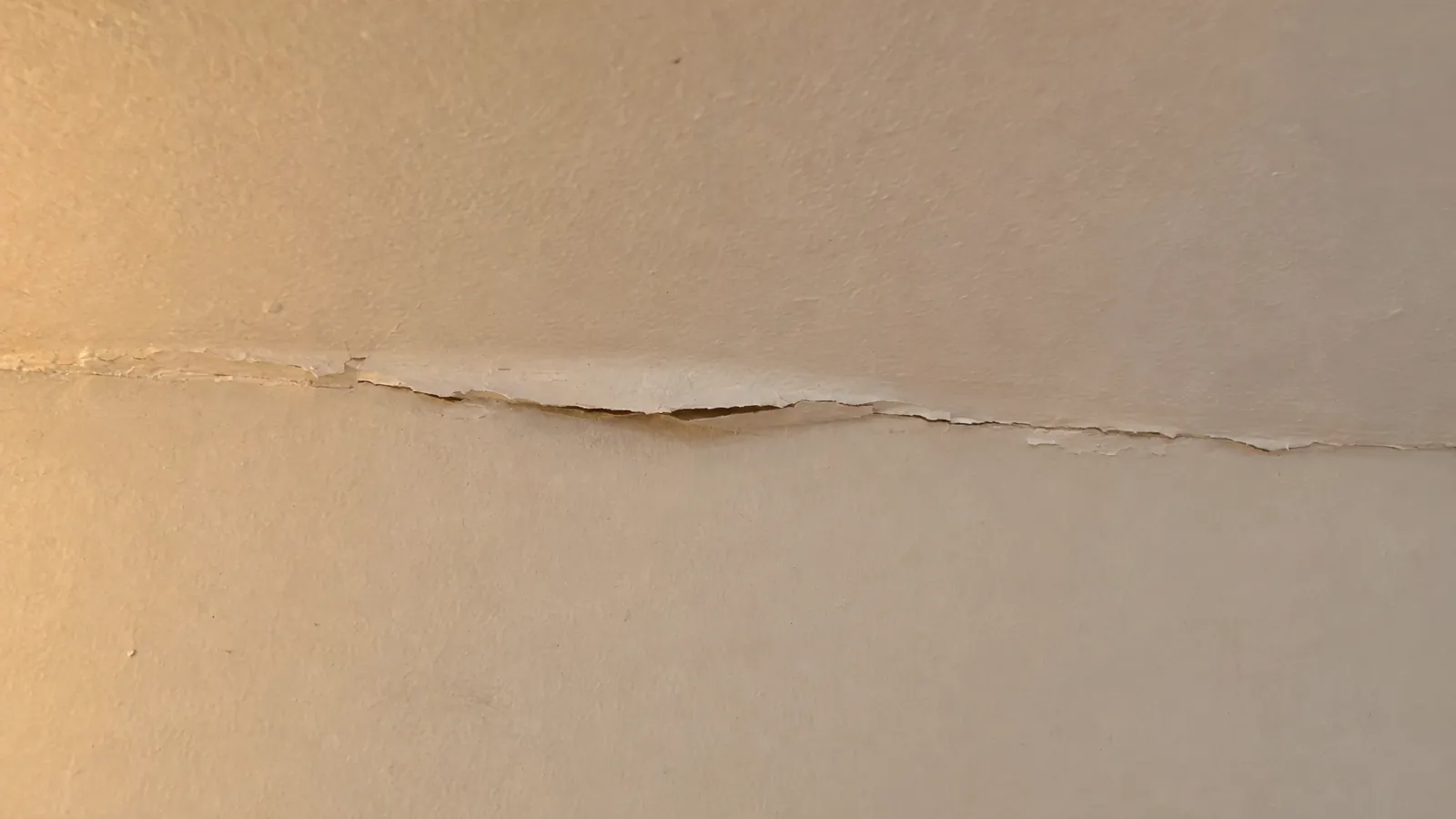
In houses framed with roof trusses, a crack can open along the line where ceiling and partition wall join in one season and close again in another, as the truss members take on and lose moisture at different rates. Rigid compound in that joint just cracks again; a flexible approach, such as refastening the ceiling edge or covering the joint with trim, is the usual answer.
Popcorn Asbestos Caution
Popcorn texture on older ceilings may hold asbestos fibers. Before anyone scrapes, sands or patches it, a small sample belongs at an accredited lab. A clean result means the patch can be re-sprayed to blend; a positive one means the work belongs with an abatement contractor first.
Ridged Joints
Long straight lines across a ceiling are usually seams between sheets, showing as the tape loosens or the compound shrinks. Re-taping the failed length and feathering it wide is what keeps the line from returning.
Stains and sags overhead are covered in more depth on the leak-damaged ceiling and wall page.
Post-1980 Housing Stock
Census housing counts spanning 2020 to 2024 show 4,829 homes in Soledad, and 2,833 of them date from 1980 through 2009. The 2000s alone account for 1,376 of today's homes, more than any other decade, with another 732 from the 2010s. About three in four homes here are detached houses. Homes from those decades are typically finished with drywall over wood framing, and as they age they show a familiar handful of problems.
Settling Lines
Diagonal cracks running up from the top corners of doors and windows, where the header and jack studs over each doorway or window gather movement. Soledad's very warm, close to rainless summers and wetter winters mean the soil under a slab dries and takes on water with the seasons, and the walls above register it at those corners.
Popped Fasteners
Little domes or rings of split paint over nails and screws, usually from framing lumber drying and shrinking after the house was finished. Each one is reset with a screw driven just beside it, then covered and textured.
Truss Movement
Gaps that come and go where ceilings meet interior walls, covered in the ceiling notes above. They are cosmetic, but they return if they're filled with rigid compound.
One caution: a crack wider than about an eighth of an inch, a stair-step pattern, or doors that no longer latch all point toward a structural engineer or foundation contractor looking at the house before any drywall is patched. Compound over a wall that is still moving just postpones the crack.
The crack repair page explains how corner and seam cracks are opened, taped and refinished.
Salinas Valley Towns
Soledad is the center of the service area, with the Salinas Valley towns up and down US 101 covered too.
- Soledad
- Every neighborhood in town, from the older blocks to the subdivisions built out from the 1980s on.
- Gonzales
- Eight miles northwest on US 101, the city that calls itself the Wine Capital of Monterey County.
- Chualar
- The unincorporated community about 10 miles southeast of Salinas, alongside US 101.
- Salinas
- The county seat, 21 miles northwest, where the Salinas Valley opens toward the coast.
- Greenfield
- Nine miles southeast on US 101, nicknamed the Broccoli Capital of the World.
- King City
- On the Salinas River, 13 miles past Greenfield along the same highway.
Post-Leak Order
When water reaches a wall or ceiling, the order of the next steps matters more than their speed.
Power First
If water is coming through a ceiling, switch off the breaker for the lights and fans in that area before anything else, and keep people out from beneath any bulge. Then close the shutoff valve at the fixture, or the house main when the source is a mystery.
Source Repaired
A plumber or roofer fixes the cause. New drywall goes up only after the repair is done and tested; otherwise the fresh patch simply absorbs the next leak.
Drying Out
Open the room, run fans, and pull out wet insulation where it can be reached safely. Soledad's dry summer air helps, but board inside a closed wall cavity stays damp far longer than its painted face suggests.
Meter Readings
Ahead of any new board going up, readings are taken on the old board and framing with a pin or pinless meter and compared with a dry wall elsewhere in the house. Readings decide when it's dry, not appearance.
Cut Lines
Board that crumbles, sags, smells musty or stays wet comes out, trimmed back to firm gypsum and replaced. Board that dried firm and flat can often stay under a coat of stain-sealing primer.
Breaker Before Bucket
Water and ceiling fixtures share the same space. Shutting off the circuit before anything else protects whoever is standing below with the bucket.
Phone or Message
Describe the damage in a call, a few lines on the message page, or a photo by text. Whichever you choose, you see a price before a single tool comes out.
Explain it once; the contractor who picks up the job phones you back and arranges the quote.